Morphology has quickly become a buzzword in the science of reading community. But if you’re unsure what it is or how to teach it, you’re not alone. In this post, we’ll break down the different types of morphemes, why morphology matters for reading and spelling instruction, common mistakes people make when teaching it, and how to teach morphology effectively.
What is Morphology?
Morphology is the study of morphemes: the smallest units of meaning that make up words. Morphemes include affixes (prefixes and suffixes) and bases.
Free bases can stand alone. For example, the word play is a free base. Free bases can have more than one syllable.
Bound bases cannot stand alone. They must be connected to one or more affixes to form a word. For example, the Latin root rupt is a bound base. When attached to affixes, it forms words like erupt, rupture, and interrupt.
Prefixes come before bases. Common examples include re-, un-, im-, de-, sub-, dis-, mis, non-, and over-.
Suffixes come after bases. Common examples include -s, -es, -ing, -er, -est, -ly, -less, and -ful.
Here are some examples of words broken down into their morphemes:
- cats → cat + -s
- replay → re- + play
- unpacking → un- + pack + -ing
- disruption → dis- + rupt + -ion
Why Teach Morphology?
Studies have shown that teaching morphology significantly improves literacy achievement. (Source) Morphology instruction can help students strengthen their spelling, vocabulary, and comprehension skills. It can be particularly beneficial to students who struggle with reading. (Source)
✏️How Morphology Helps with Spelling
If you’re naturally good at spelling, you probably don’t think about morphemes much. But for students who are still learning to spell or struggling with spelling, morphology can be an incredibly helpful tool.
Imagine a first grader trying to spell the word “camped.” If they attempt to spell the word using the sounds alone, they will likely hear a /t/ sound at the end and write campt. However, if they’ve been taught that the suffix -ed is used to make words past tense and can represent three different sounds, they will realize that the correct spelling is camped.

Similarly, let’s think about a fifth grader attempting to spell the word “unnatural.” At first, they can’t remember if the word has one n or two. But then they realize that the prefix un- is being added to natural, they know it must be spelled with two n’s.
📖How Morphology Helps with Decoding
Knowledge of morphology makes a big difference when decoding multisyllabic words. Coming across a word like disconnection can be overwhelming if you don’t immediately recognize the prefix dis- and the suffix -ion, and sounding it out would be nearly impossible.
Students who learn common affixes and bases are much better equipped to break down big words quickly.
🧠How Morphology Helps with Comprehension
Knowledge of morphemes also supports reading comprehension and vocabulary development by helping students understand the meaning of new words more easily.
Imagine a student reads this sentence in a passage: “Reindeer mainly live in forests and tundras of the Arctic and subarctic.”
Suppose the student has never heard the word “subarctic.” However, they have learned that the prefix sub- means under or below, and they can associate it with words they know, like subtract and submarine. This helps them to infer the meaning of this new word.
Common Mistakes when Teaching Morphology
I made a lot of mistakes when I was first learning how to teach morphology. Here’s what I wish I’d known sooner.
Mistake #1: Waiting too long to teach morphology
Many teachers believe that morphology should come after phonics, and most literacy programs reinforce this misconception. The truth is, morphology instruction begins as early as kindergarten. When we introduce plural words with the suffix -s, we are teaching morphology!
To truly orthographically map words, students need to know the sounds, the spelling, and the meaning. So teaching morphology in conjunction with phonics just makes sense!
| Morphology Instruction by Grade Level | |
| Kindergarten & 1st Grade | Inflectional Endings (-s, -es, -ed, -ing) |
| 2nd & 3rd Grade | Common Prefixes & Suffixes (-er, -ly, -est, -ful, re-, un-, dis-, etc.) |
| 4th & 5th Grade | More Challenging Affixes, Latin & Greek Roots |
Mistake #2: Teaching Morphology in Isolation
I taught my students prefixes and suffixes, but I often did this as an isolated activity. We would learn a morpheme, recite it a few times, and look at some example words. If the morpheme came up organically in a text we were reading, great! But that was as far as I typically went.
I now know that morphology instruction is much more effective if it’s connected to meaningful context. Science or social studies passages can be great for helping students practice morphology in an authentic context while also building their content knowledge.

Mistake #3: Forgetting to Spell the Morphemes
We often have students practice reading morphemes just as they would practice graphemes. For example, a teacher may hold up a card with the prefix un- on it, and the students would read /un/. But it’s actually more effective to have students spell the morpheme, because the pronunciation of a morpheme can change depending on which word it is attached to.
One common example is the suffix -ed, which can have three different sounds: /t/, /d/, or /id/.
Another example is the root “sign.” It is pronounced differently in “assign” and “signature,” but has the same meaning and spelling in both words.
Personally, I like to have students spell the morpheme and then pronounce it. If it has multiple pronunciations, we will say them all.
How to Teach Morphology
If you’re ready to get started with morphology instruction, here are some practical strategies you can implement.
🗨️Verbal Activities
When you are first beginning morphology instruction or working with younger students, starting with verbal practice can be very helpful. Model some examples first, and then have students chime in. This is also a great way to introduce a new morpheme.
- “I don’t have one box, I have two boxes.”
- “I am jumping right now. Yesterday I jumped.”
- “This morning I packed my lunch. Now I am going to unpack it.”
It’s even more fun if you can act these out!
🎶Morpheme Chants
I love using catchy chants to help students remember new morphemes, especially in the younger grades. Here are some examples I have used:
- u-n un: not, not, not
- n-o-n non: not, not, not
- r-e re: again, again, again
- f-u-l ful: full, full, full
- d-i-s dis: opposite of
- l-e-s-s less: less, without, less
- p-r-e pre: comes before
We added simple hand motions to each of these. For example, for un- and non-, we made an X with our arms. For -ful, we rubbed our bellies.
🔨Practice Building Words
It can be helpful for students to see how morphemes fit together by building words themselves. For example, you can give students cards with different bases and affixes and have them try different combinations to see how many words they can build.
This free game by Phonics and Stuff is a fun digital option. There is a new puzzle each day, and some are more challenging than others. It’s even helped with my own morphology knowledge!
📖Connect it to Text
Teaching morphology in context allows for deeper understanding, improved retention, and meaningful connections.
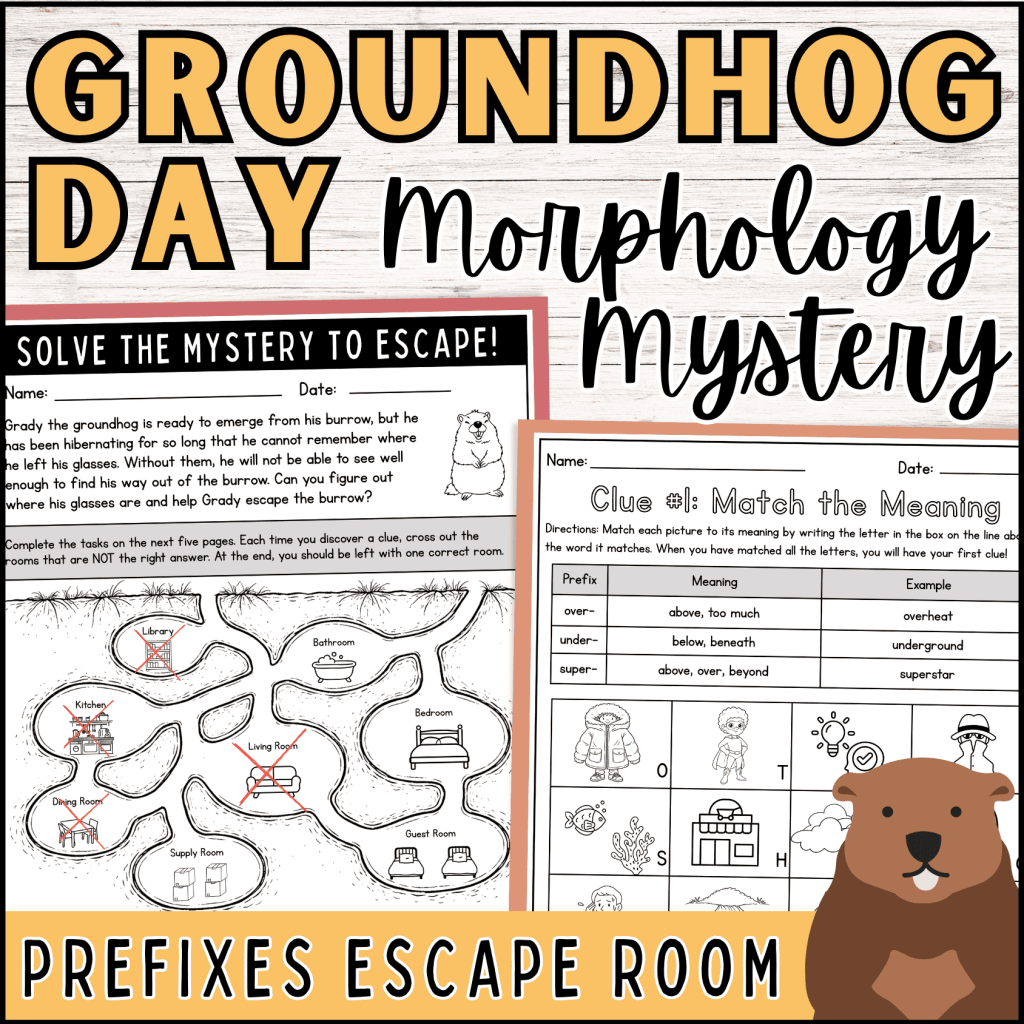
One way to connect morphology instruction to text is to look for passages that intentionally target specific morphemes. I have some decodable passages that focus on prefixes and suffixes, and I’ll be adding more soon.
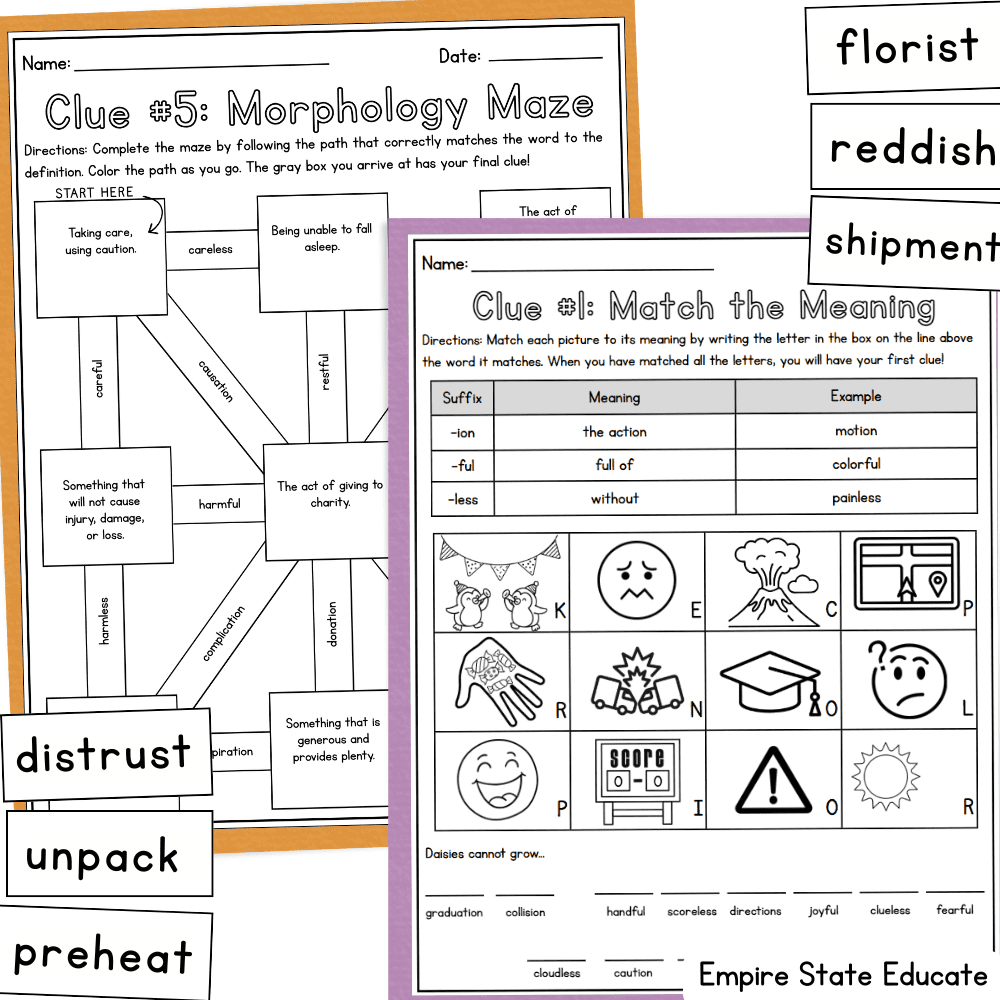
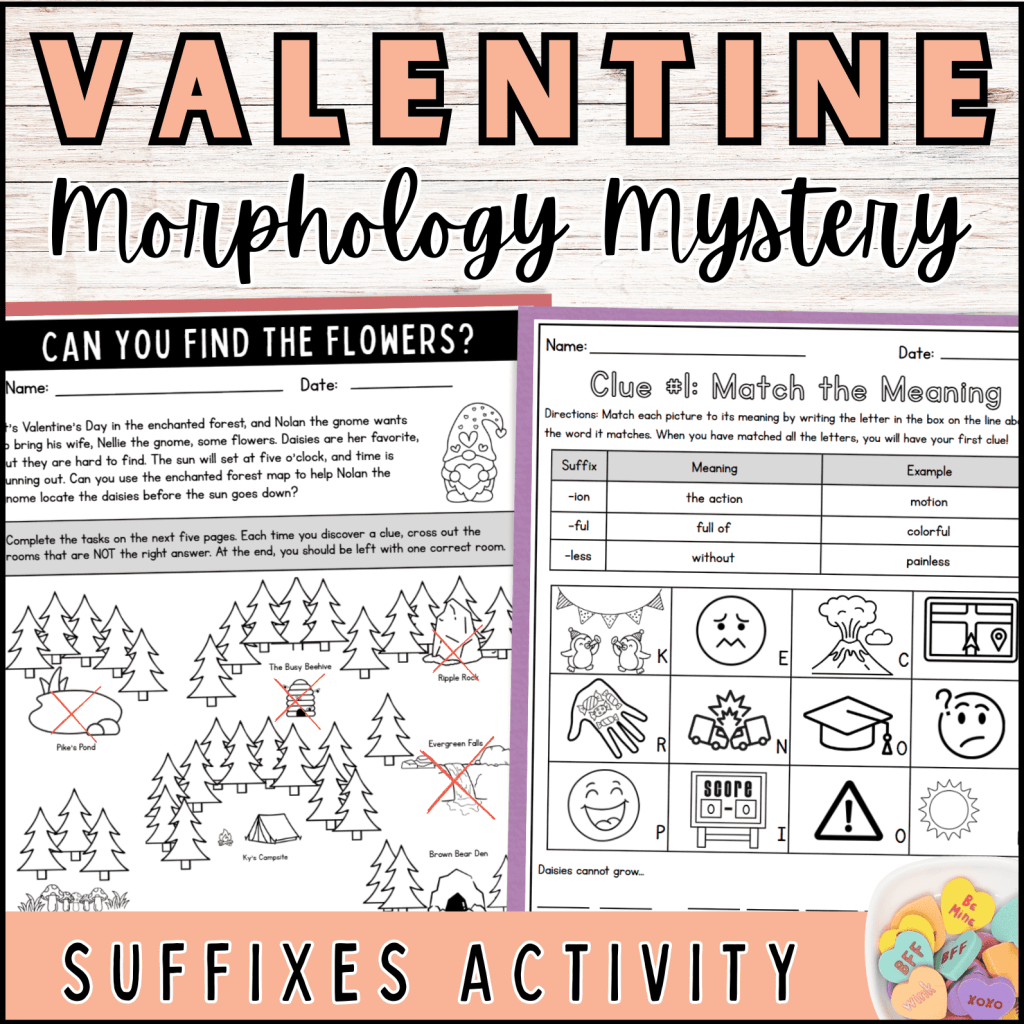
My “Morphology Mysteries” include reading passages that teach morphemes in context. Each one has five activities that students complete to reveal clues and solve the mystery.
Another way is to begin with a high-quality text and tailor your morphology instruction around it. For example, if you’ve already planned to read a passage about butterflies as part of your science lesson, check to see if it already contains morphemes you could teach or review.
As you can see, morphology instruction doesn’t have to be complicated or overwhelming. Once you grow comfortable with it, it can actually be a lot of fun. Stay tuned for more posts on this topic, and check out all my morphology resources here!