As a child, I had no idea why some words were spelled with a c and some were spelled with a k. I had certainly never heard of the cat and kite spelling rule. I was good at spelling, and I enjoyed it – I even made it into my school spelling bee in fourth grade! But I was relying solely on memorization. I didn’t actually understand why words were spelled the way they were.
I didn’t learn about the cat and kite rule (also called the c or k rule) until after college! But it’s truly a must-teach rule in your spelling and phonics instruction. I have a feeling there are still some teachers and parents who don’t know this rule. So, let’s talk about the cat and kite spelling rule, why it matters, and how to teach it!
What Is the Cat and Kite Spelling Rule?
The Cat Kite rule states that:
If the /k/ sound comes before an i or an e, it is spelled with a k. If the /k/ sound comes before an a, o, or u. It is spelled with a c.
Examples:
- kid
- key
- camp
- cone
- cup
✔️ Common Exceptions
Some words that do not have English origins break the cat and kite rule. This is a good opportunity to discuss the origins of these words and point out that they do not follow the rule because they did not originate from English.
- kabob
- kayak
- koala
- skunk
- kangaroo
- kale
But what about words like cent, city, and cell?
You may have some sharp-witted students who are eager to point this out. The cat and kite rule does not apply to these words because they do not have the /k/ sound. In these words, the c is spelling its soft sound, /s/.
Why Should You Teach the Cat and Kite Spelling Rule?
The obvious reason to explicitly teach this rule is that it helps students know how to spell words that contain a c or a k. But knowing this rule can also help students distinguish between hard c and soft c. The letter c spells /k/ when followed by an a, o, or u. It spells /s/ when followed by an e, i, or y.
🕒 When Should You Teach the Cat and Kite Spelling Rule?
This rule can be taught as early as kindergarten. Many CVC words are spelled with a c or a k, so it’s a great time to explain why!
If you have older students who consistently misspell words with a c or a k, it’s possible that they never learned this rule, or they need to review it.
🧠 Ideas for Teaching the Cat and Kite Rule
Word Sorts
Word sorts make a great “hook” when introducing a new spelling rule! Depending on your students, you could provide the categories for them (c or k), or you could encourage them to come up with their own categories. Once the words are sorted, ask students what they notice.
Then, explicitly teach the spelling rule. Say, “If the /k/ sound comes before the letter i or e, then we spell it with a k. If it comes before an a, o, or u, then we spell it with a c.” Point out examples for each vowel.
🎶 Cat and Kite Rule Rhyme
To help students remember the rule, I use this simple rhyme:
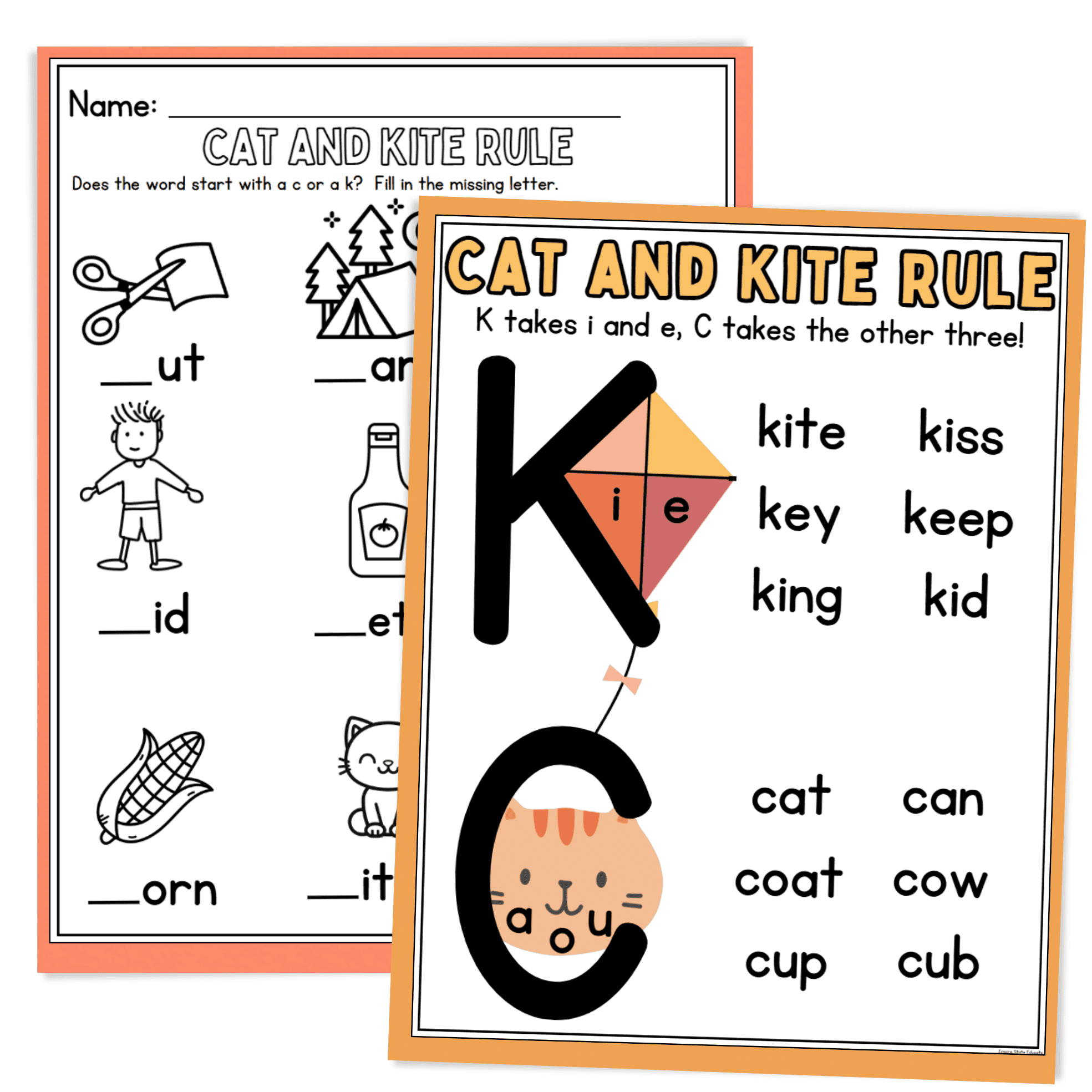
“K takes i and e – C takes the other three!”
You can even extend it by adding:
“C takes a, o, u – K takes the other two!”
Visual Reminders
I recommend hanging a poster or another visual reminder to help students remember the rule, especially when they are first learning it.
Poster & Activities
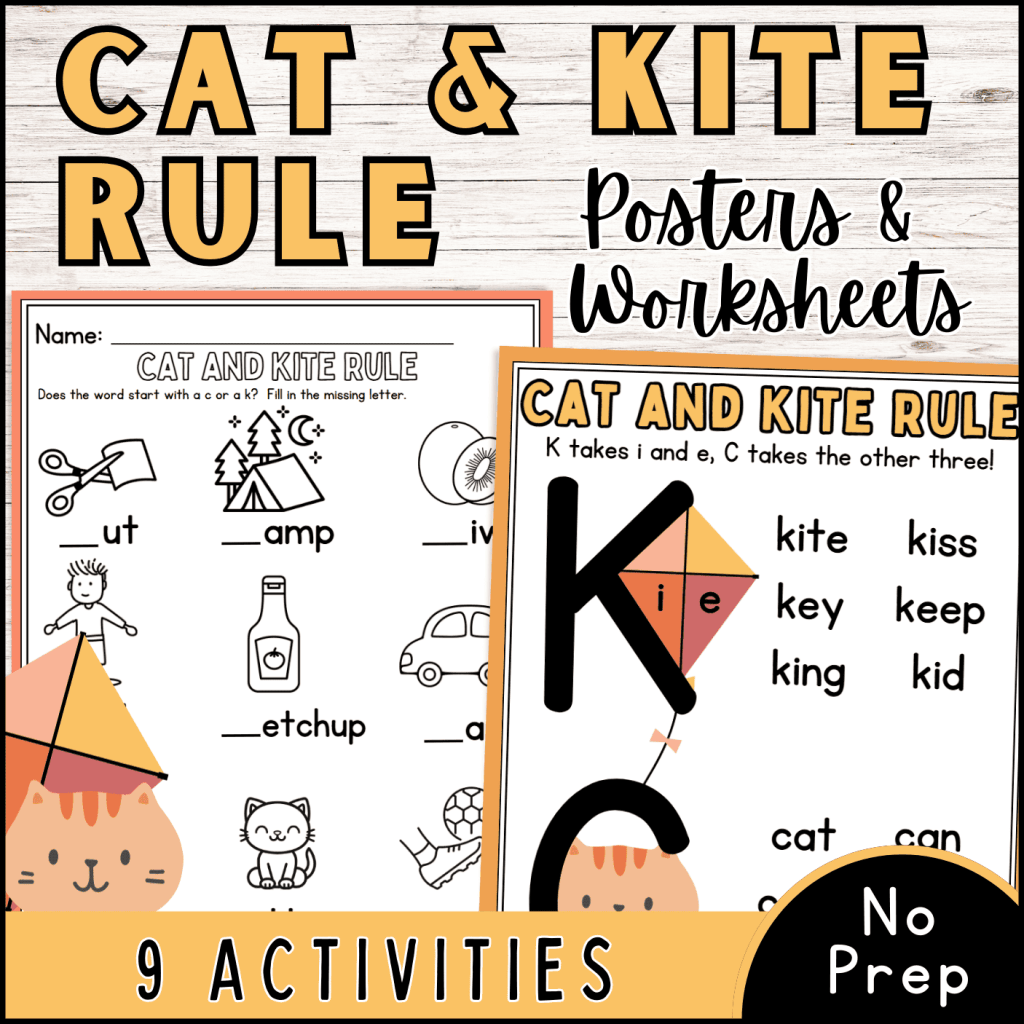
This $3 resource includes a Cat & Kite Spelling rule poster and nine worksheets to help students practice this rule. It includes sorting, spelling, and coloring activities to keep students engaged!
You may also want to check out my post about the FLOSS Rule, another must-teach spelling rule!
📝 Cat and Kite Rule Word List
“Kite” Words
- kid
- kit
- kiss
- kite
- kind
- king
- keep
- key
- kitten
- ketchup
“Cat” Words
- cat
- cup
- cot
- camp
- car
- coat
- cow
- cool
- curb