Consonant le syllables are one of the six syllable types. They are typically taught in first or second grade, but older students and struggling readers can benefit from reviewing this often tricky syllable type.
In this post, I’ll walk you through what consonant le syllables are and how to teach them. I’ll also include a free list of consonant + le words!
What Are Consonant + LE (C+LE) Syllables?
A consonant le syllable is a final stable syllable. This means:
- It cannot stand alone. It’s always attached to another syllable.
- The rest of the word does not impact its pronunciation- it’s always pronounced the same way.*
There are nine letters that can be attached to the le. They are:
- -ble
- -ple
- -tle
- -dle
- -gle
- -kle
- -cle
- -zle
- -fle
*There is an exception! The English language is full of fun surprises, isn’t it? C+LE syllables are always pronounced the same way, except in words that have the letter s before -tle.
Examples:
- castle
- whistle
- hustle
In Old English, the t used to be pronounced in these words. Over time, people found that this consonant cluster was too tricky to say quickly, so the pronunciation gradually changed. That’s why the t is silent in these words today.
When should you teach consonant le words?
Popular phonics sequences vary on when to teach consonant + le. UFLI teaches it as an ending spelling pattern after -tch, -dge, and the suffix -y. IMSE does not teach it until after teaching vowel teams and r-controlled vowels. When it comes to teaching phonics, there is no one correct order. The most important thing is to ensure instruction is systematic, building upon past concepts. Your students may be ready for consonant + le words if they:
✅Can decode open, closed, and silent e syllables
✅Can decode 2-syllable words with open and closed syllables
✅Can decode consonant blends
What makes them tricky?
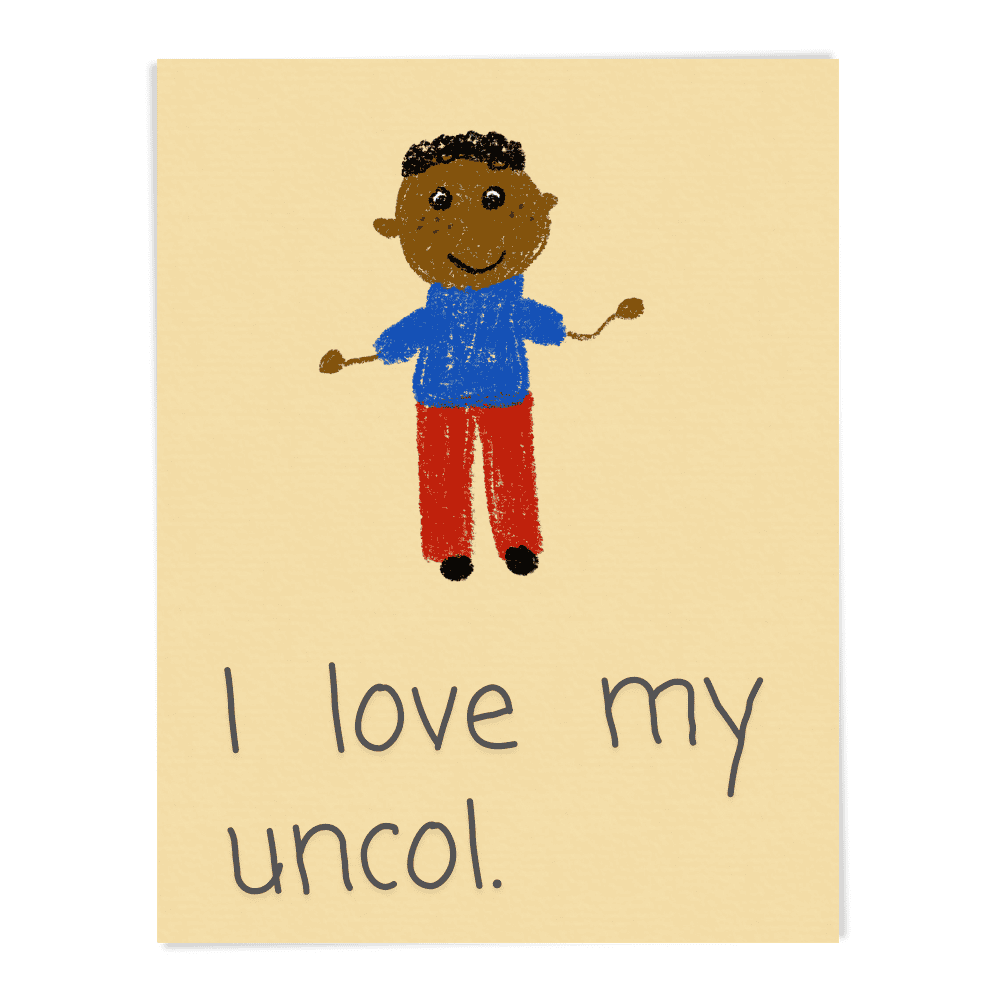
Consonant le syllables can be tricky because they have a schwa sound. For example, -ble is pronounced: /bul/. That’s why students often spell words like “uncle” as “uncul” or “uncol.” Explicitly teaching consonant le syllables can help avoid that!
Double or Single Consonant:
Words that start with a closed syllable, like little and giggle, have double consonants. This shows that the vowel is short.
Words that begin with an open syllable, like title and cable, do not have a double consonant. This shows that the vowel is long.
This pattern is important for both decoding and encoding! While many students can pick up on this pattern on their own, others will need explicit instruction.
How to Teach Consonant + LE Words
1. Explicitly teach the pattern.
Consonant + le should be introduced as a new syllable type. It helps if your students are already familiar with other syllable types like open, closed, and VCE.
I tell students, “A consonant le syllable has a consonant followed by an le. It cannot be by itself. It always comes after another syllable.” Then, I teach the consonant + le spelling patterns a few at a time using a multisensory approach. So, I may have them say, “g – l – e spells /gul/” while I show them the grapheme card and they write it using sand or another tactile material.

2. Use a word sort
I like having students do a word sort when introducing any new phonics concept or syllable type. I lay out 8-12 word cards and ask students to sort the words into categories. You can do a closed sort, where the categories are predetermined, or an open sort, where the students have to determine the categories themselves. In this case, the students would be sorting the words by ending. As you get more advanced, you could also have them sort by the first syllable type (open + CLE vs closed + CLE).
3. Practice Syllable Division
In order to decode consonant-le words, students will need to break them into syllables.
When students are first learning this, they can use this method:
Start at the end → count back three letters → divide
Example:
c a n | d l e
ta | b l e
pur | p l e
🐢Some people refer to this at the turtle rule for syllable division.
🎶 Students can use this rhyme: “Consonant + le? Count back three!”
Once students are familiar with the C+LE endings, they will begin to recognize them as units and divide with more automaticity.
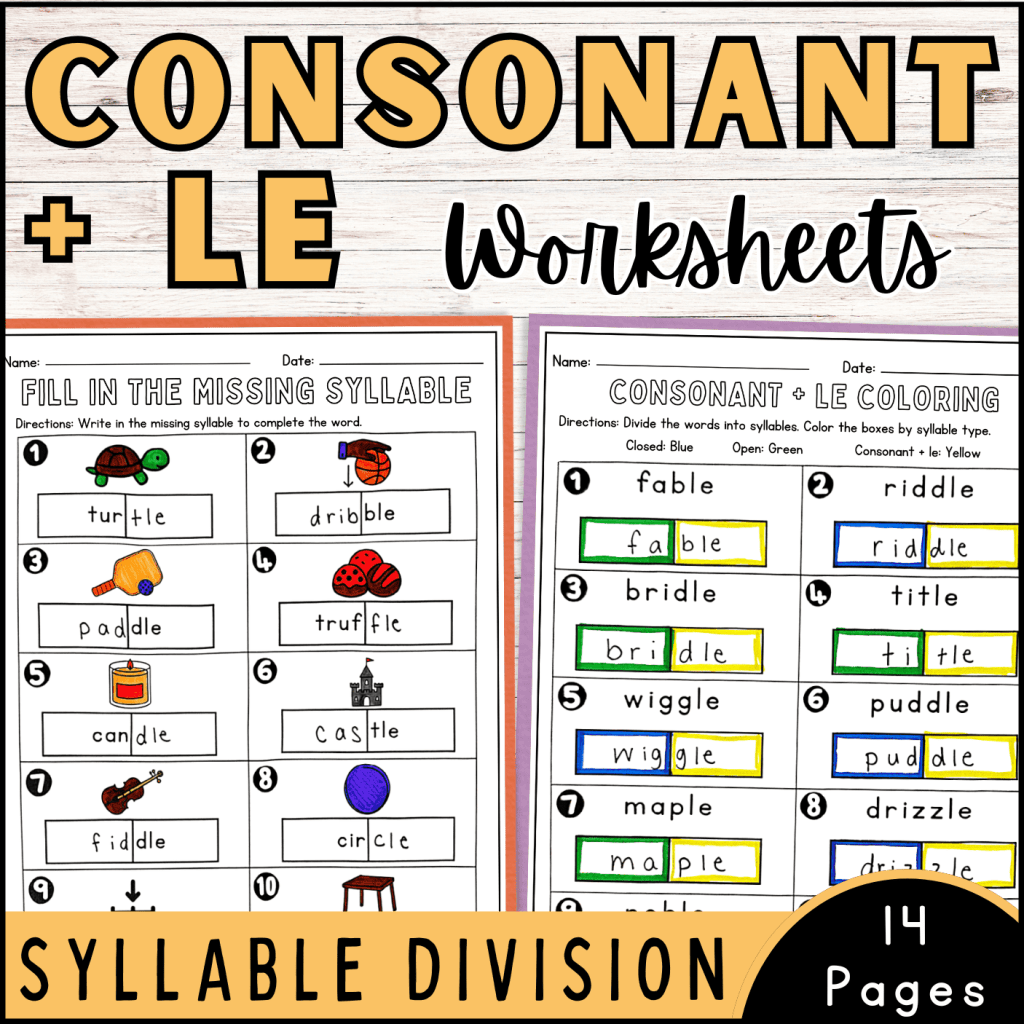
These worksheets are great for practicing C+LE syllable division.⤵️
4. Use word chains
Word chains are a great tool for multisyllabic words, too! Start with one consonant + le word. Then, have students change one syllable at a time to create new words. Here are some examples you can try:
- cable → fable → table → stable → staple → maple
- rubble → bubble → fumble → tumble → ramble
- tangle → mangle → mantle → little → title
5. Practice with decodable text
Once students demonstrate success decoding these words in isolation, be sure to have them practice in context with decodable text.
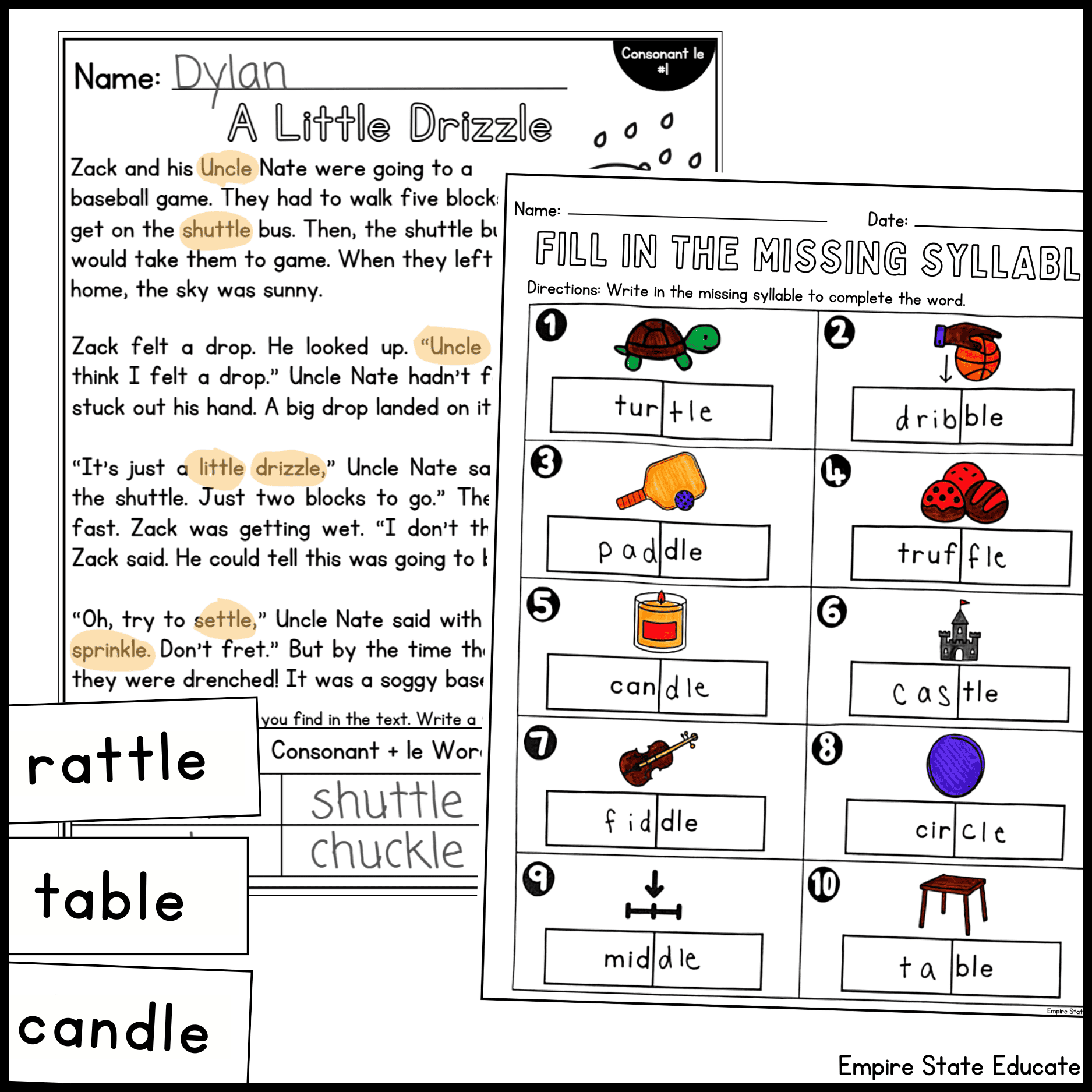
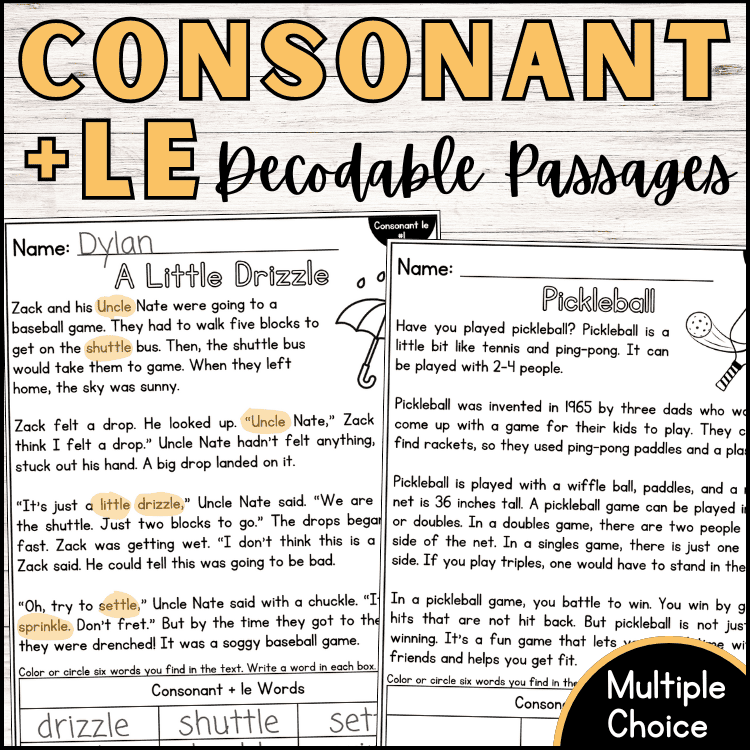
This resource in my TPT store includes 3 engaging decodable passages with comprehension questions. ⤵️
C+LE Word List (Sorted by Ending)
-BLE Words
table, cable, fable, bubble, scribble, nibble, bible
-CLE Words
circle, uncle, pickle, freckle, buckle
-DLE Words
candle, handle, bundle, middle, riddle, bridle
-FLE Words
raffle, sniffle, truffle, shuffle
-GLE Words
giggle, wiggle, juggle, smuggle, tangle, struggle
-KLE Words
sparkle, tackle, tickle, crackle, speckle, sprinkle, ankle
-PLE Words
simple, purple, sample, temple, maple, staple, ripple
-TLE Words
little, bottle, kettle, settle, brittle, rattle, cattle, title, turtle
-ZLE Words
puzzle, sizzle, dazzle, drizzle, fizzle
Get a Printable Consonant Le Word List
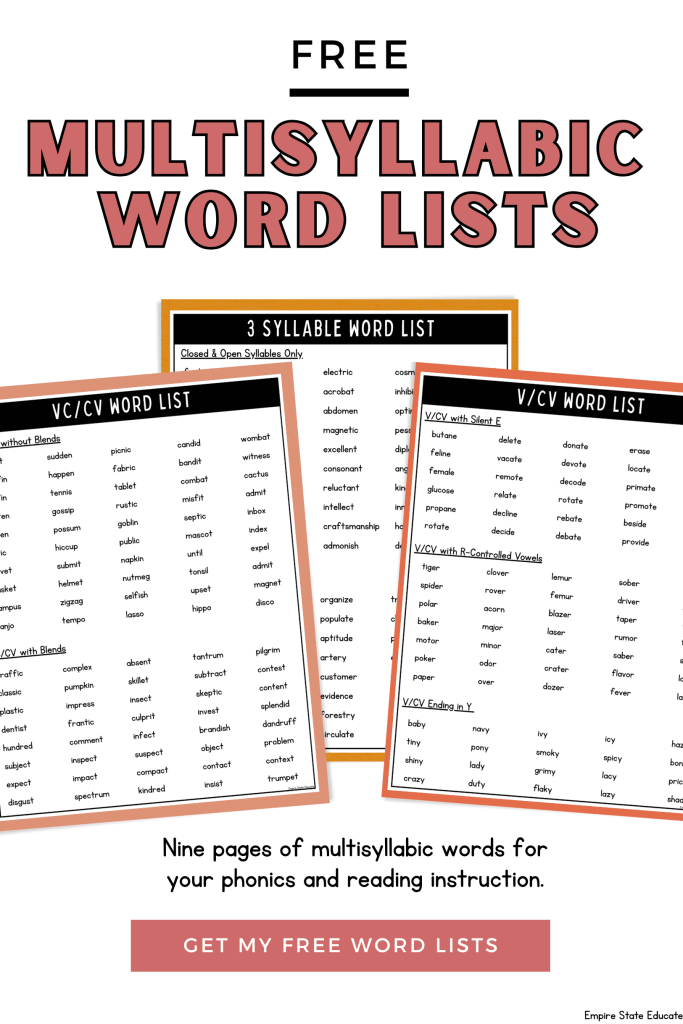
Need more words? Download my free multisyllabic word lists. You’ll get nine pages of multisyllabic words organized by syllable type and syllable division pattern.