
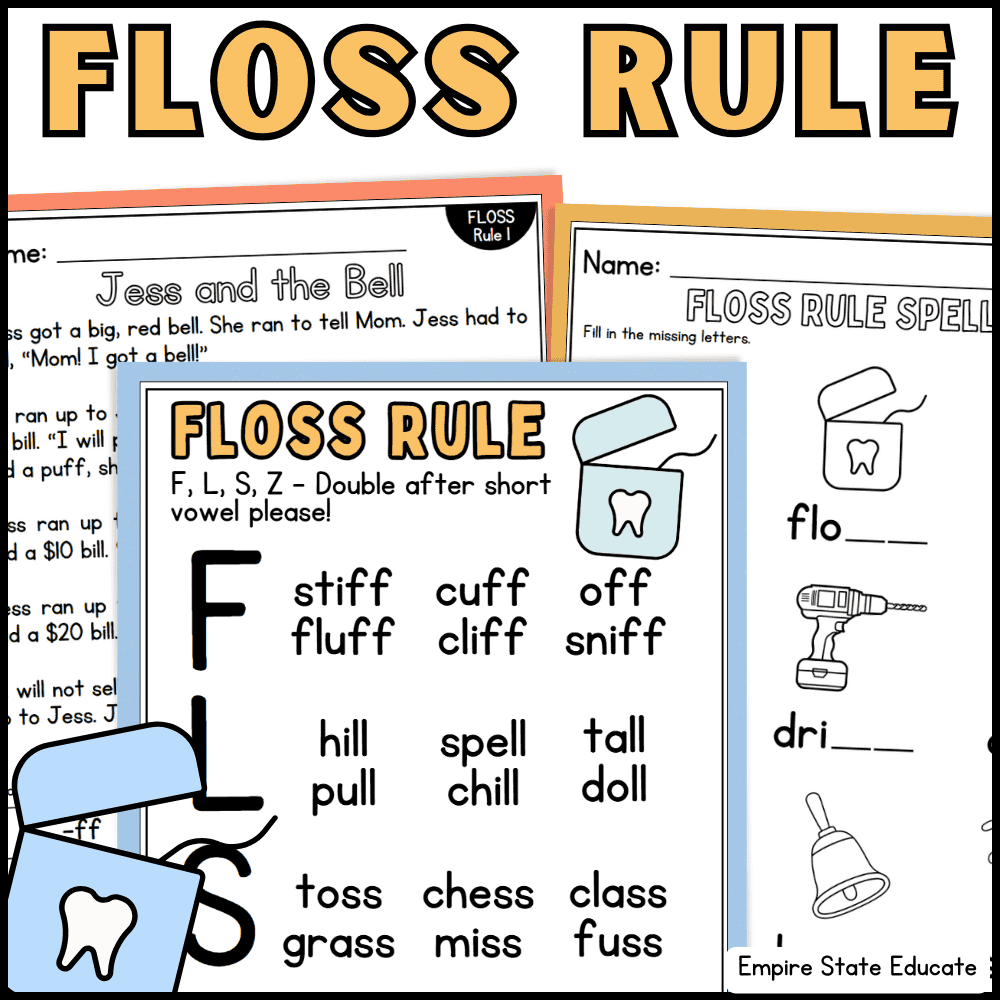
The FLOSS Rule is one of the very first spelling rules that I teach. (It can also be called the FLSZ rule or FLoSS + Z rule.) Most readers are ready to learn the FLOSS rule at the end of kindergarten or the beginning of first grade, but it can be beneficial to review this rule in second grade and beyond.
In this post, I’ll share my best tips and resources for teaching the FLOSS rule. I’ll also share a free word list and a simple chant your students will love!
🦷 What Is the FLOSS/FLSZ Rule?
The FLOSS/FLSZ Rule states that:
If a one-syllable short vowel word ends in the sound /f/, /l/, /s/, or /z/, then the final consonant is doubled.
Examples:
- stuff
- hill
- mess
- buzz
Common Exceptions:
Expections to the rule include the high frequency words if, is, his, has, was, yes, and this. Other common expections are:
- gas
- pal
- bus
Why is the FLOSS rule important to teach?
It’s much easier to spell words like shell, kiss, and bull if you understand why they are spelled that way. But it’s also important to teach because it’s a short vowel pointer. When we see the spellings ff, ss, ll, or zz, we know to pronounce the vowel before them as a short vowel.
When is it taught?
Most phonics programs teach the floss rule after students have mastered:
- CVC words
- Common digraphs
Other programs, like UFLI, teach the floss rule before introducing digraphs. Either order is fine, as long as your students have mastered CVC words.
It’s also helpful for your students to know the difference between short and long vowels, since this rule only applies after short vowels.
Teaching Ideas
Word Sorts
I love starting with word sorts when introducing new spelling patterns! To start, I lay out 8-12 word cards and ask students to sort the words into categories. Depending on your students, you can do a closed sort, where the categories are predetermined, or an open sort, where the students have to determine the categories themselves.
If I were doing a closed sort, I would have the headings -ll, -ss, -ff, and -zz laid out. I personally prefer open sorts because they require the students to think critically and pay close attention to the spelling of each word.
Once students have sorted the words, I would ask them what they notice. I would then explicitly teach the rule. I would say, “If a one-syllable short vowel word ends in an f, l, s, or z, then we double the final consonant.”

🎶 FLOSS Rule Rhyme
To help students remember the rule, I teach this simple rhyme:
“F, L, S, Z —
Double after short vowel, please!”
Students love saying this chant when we encounter a floss rule word! Just be sure to remind them that this only applies to one-syllable words.
(I did not write this rhyme, and I wish I remembered who I learned it from!)
Word Mapping
When mapping words that follow the FLOSS rule, emphasize that the double consonant represents one sound. If you are using Elkonin boxes, place the double consonant in one box.

✨You can get my FREE floss rule word mapping worksheets here.
Word Chaining
Word chaining is another one of my go-to strategies. Give students one starting word and prompt them to make a new word by changing one phoneme at a time. For example, I may have students start with the word miss and then prompt them to “change miss to kiss.”
This activity is great because it incorporates a lot of phonemic awareness. Students have to identify the phoneme that is changing and substitute it for a new one.
Here are a few example word chains that you can try:
- miss → mill → bill → bull → tall → tell → yell
- mess → miss→ hiss → hill → hull→ pull → puff
- buzz → fuzz→ fizz → fill → full→ gull → gall
Visual Reminders
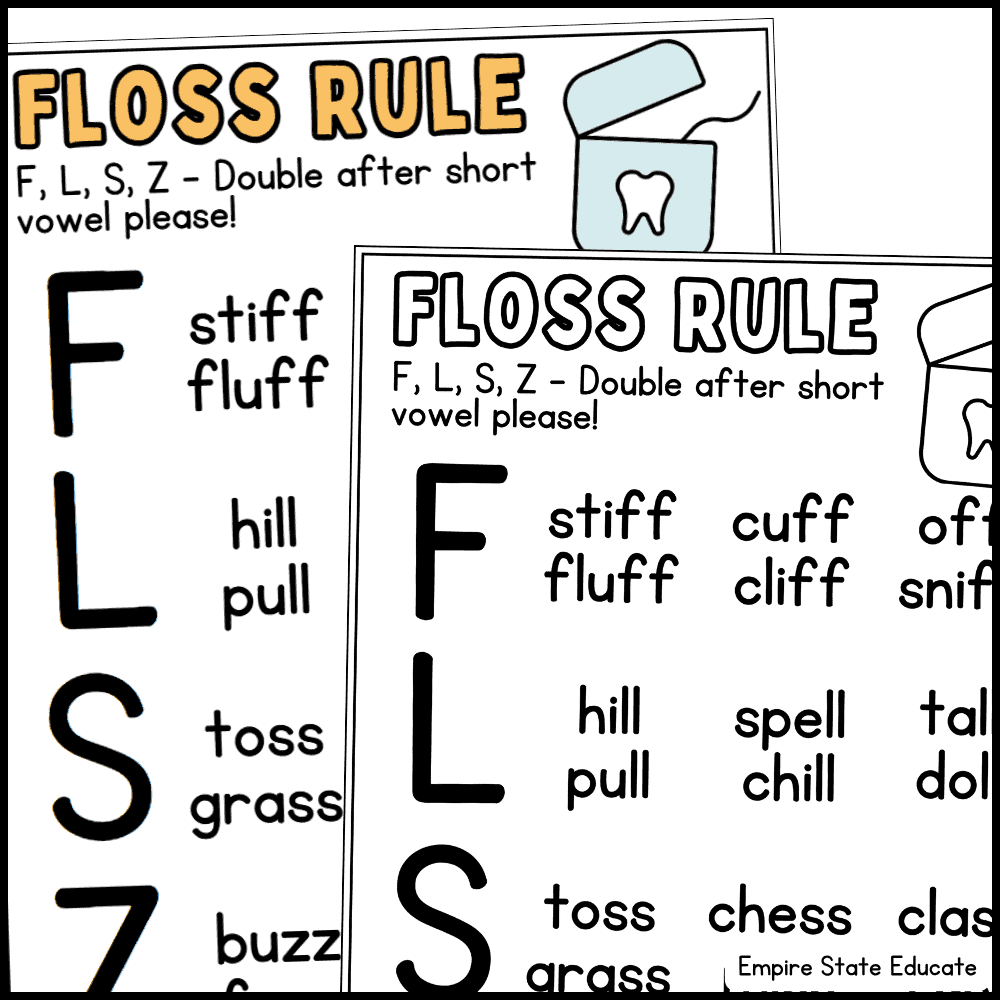
Lastly, I recommend hanging a poster or another visual reminder to help students remember the rule, especially when they are first learning it.
Resources
If you’re getting ready to teach this spelling rule, this mini-bundle of activities is a great resource to start with. It includes decodable passages with comprehension questions, cut and paste word sorts, spelling worksheets, word cards, and posters.

Want to learn about more spelling rules? Check out my post on The Cat and Kite Rule next!
📝 FLOSS Rule Word List
(Without Blends)
- off
- cuff
- puff
- fill
- hill
- pill
- doll
- tell
- well
- bell
- sell
- yell
- will
- gull
- miss
- hiss
- kiss
- toss
- boss
- mess
- less
- pass
- fuss
- chess
- buzz
- fuzz
- fizz
- jazz
(With Blends)
- cliff
- sniff
- stuff
- fluff
- gruff
- skill
- spill
- smell
- spell
- small
- drill
- grill
- troll
- class
- glass
- grass
- press
- dress
- gloss
- bliss
- floss
- cross
- frizz