Setting up your structured literacy small groups can be a daunting task. Ironically, I feel like organizing reading groups was easier when I followed the traditional “guided reading” framework. I gave every student a Fountas & Pinnell reading assessment and grouped students based on their “levels.” Each group had a different colored guided reading book that corresponded with their level. It may not have been effective, but it was simple!
When you begin following a structured literacy or science of reading framework, forming small groups can be a bit more challenging. You might be asking yourself: Without reading levels, what data do I use to group students? How many groups should I have? How do I fit them all in? What are my other students doing while I meet with groups? I’ll address all these questions and more in this blog post.
Guided Reading vs Structured Literacy Small Groups
Before we dive into setting up small groups, we need to understand how structured literacy small groups differ from traditional guided reading groups. Here are some key differences to keep in mind:
| Guided Reading Groups | Structured Literacy Small Groups |
| Students are grouped by reading level. | Students are grouped by specific needs. |
| Each group meets for about 15 minutes per day. | Group times are flexible and dependent on student needs. |
| The teacher plans lessons using a specific book. | The teacher plans activities to address a specific skill. |
| Students rarely switch groups. | Groups change based on data. |
| The goal for each group is general, unclear, or hard to assess. | The goal for each group is specific, relevant, and measurable. |
A lot of these were major mindset shifts for me. I also had a misconception that small group instruction was more valuable than whole group instruction. Now, I see small group instruction as a tool for supplementing high-quality whole group instruction and meeting individual student needs.
Best Assessments for Forming Reading Groups
Before you can group students, you’ll obviously need some data. To start, pick just one or two simple assessments that will give you quality information.
Some districts provide these assessments. If they tell you what you need to know, that’s great! If not, you may need to supplement with your own.
❌I would NOT rely on:
- Reading level assessments (like Fountas & Pinnell)
- i-Ready scores (or other computerized tests)
- Data from the previous school year
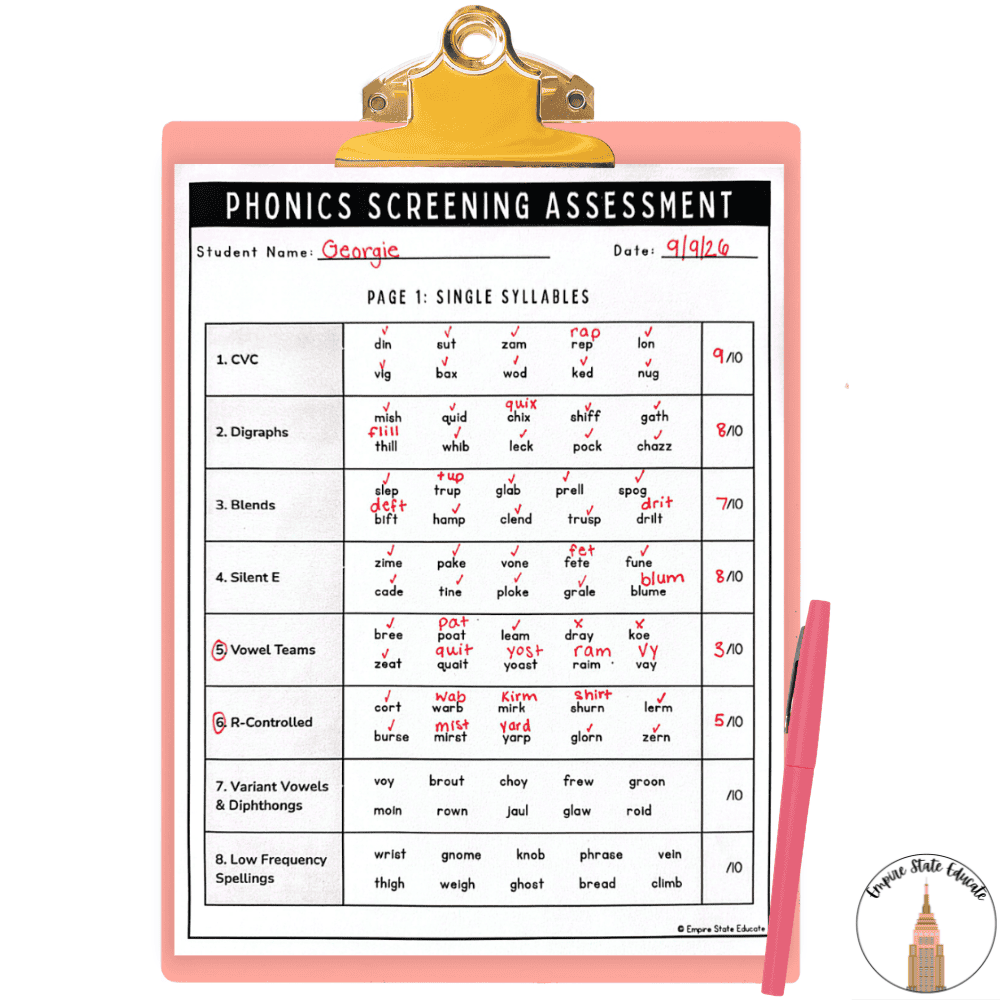
Instead, start with a phonics screening assessment. A phonics screening assessment determines which spelling patterns and syllable types students can decode. The best ones include nonsense words so students can’t rely on memorization.
I have a free phonics screening assessment ready for you to use. I designed it with one-syllable, two-syllable, and multisyllabic words, so it works for all grade levels.
Doing a decoding assessment like this phonics screener first will help you identify any gaps in your students’ decoding skills. Then, you may choose to do additional assessments with certain students.
Additional assessments you can use:
- Phonemic awareness assessment (if needed)
- Letter-sound knowledge assessment (if needed)
- Fluency assessment
- Comprehension assessment
- Spelling assessment
- Writing assessment

Free Phonics Screener
Download the free phonics screener and data spreadsheet. Figure out how to group students and where to start your instruction.
We respect your privacy. Unsubscribe anytime.
Using Phonics Data to Form Small Groups
When forming small groups, the first thing to address is decoding gaps. Students who are “missing” phonics skills from previous years will need support with those before moving on to more challenging skills. This free phonics screener includes a color-coded spreadsheet that makes it easy to see the data.
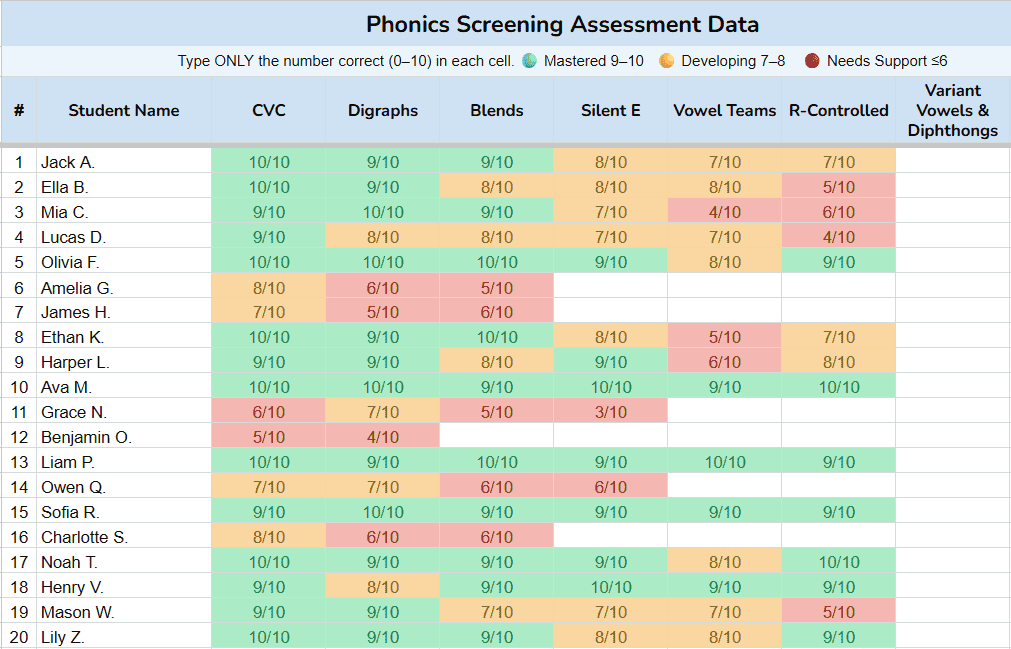
Once you input your data into the spreadsheet, it will automatically be color-coded for you. Then, follow these steps:
- First, look for any phonics skills that the majority of your class needs to review. You can address these in your whole-group instruction.
- Next, look for students with similar skill gaps. For example, three students who scored 6/10 or less on digraphs would make a good small group. Aim for 2-4 students per group, but don’t go higher than 5 or 6. Generally, the more support a group needs, the fewer students it should have.
- Finally, set a specific, measurable goal for each group. This will guide your instruction and help you determine how much time you’ll need with them.
💡When grouping students, start with the most basic skill they need support with. For example, “Grace” scored in the red for CVC, blends, and silent E, but we need to address CVC words first.
Here’s how I might initially group students using the data above:
| Group | Starting Goal | Notes |
| Grace & Benjamin | Decode CVC words with 90% accuracy | Also assess phonemic awareness and letter-sound knowledge |
| Amelia, James, Charlotte, Owen | Decode blends & digraphs with 90% accuracy | Also review CVC words |
| Mia, Ethan, Harper, Lucas | Decode vowel teams with 90% accuracy | Also review silent e |
| Ella, Mason, Jack | Decode R-Controlled vowels with 90% accuracy | Also review vowel teams |
| Olivia, Noah, Henry, Lily, Ava, Liam, Sofia | TBD | No decoding gaps – assess fluency and comprehension next |
If you have one or two students who don’t fit perfectly in a group, put them in the closest fit for now. If you have students with no decoding gaps (yay!), use additional assessments to see if there is anything else they need support with. Remember, these are just your initial groups- they can and will change!
Structured Literacy Small Groups Schedule
Fitting in all the groups is one of the hardest parts of this process, especially if you end up with several smaller groups. Remember:
- You don’t have to meet with every group for an equal amount of time.
- You don’t have to meet with every group every day.
- You don’t have to stick to the same schedule forever.
To keep things organized, I like to create three different “types” of small groups.
“Intervention groups” are for students with big decoding gaps who need a high level of support. Typically, intervention groups stay fairly consistent. These students need daily individualized instruction, support, and feedback. They benefit from predictable routines and repeated practice.
“Quick intervention groups” are for students who need targeted support with a specific skill. They may need to review a specific phonics pattern, improve their fluency, or practice answering a specific type of comprehension question. These groups change more frequently as different needs arise.
Finally, “enrichment groups” are students who don’t currently need any support but would benefit from a book study, reader’s theater, a research project, or another group activity.

With those three types of groups in mind, here’s how to start building your schedule:
- Figure out how much time you have for small groups. (If your schedule is not set for you, plan for 40-50 minutes and use less if possible.)
- Block off any times when students will be pulled out for services so you don’t schedule their group during that time.
- Schedule your high support “intervention groups” for 10-15 minutes per day.
- Schedule your “quick intervention” groups for about 5-8 minutes each. For more flexibility, schedule one block of time for quick interventions.
- Schedule one or two times a week to meet with your enrichment group(s).*
*You may not have any enrichment groups at the beginning of the year, which is okay!
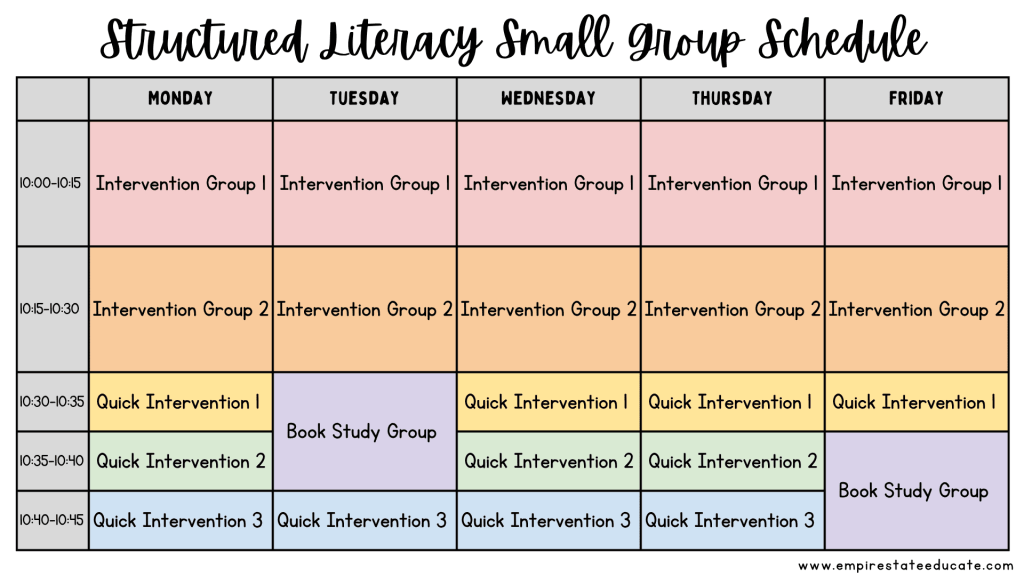
This is just one example of a small group schedule. Yours will depend on your students and their needs.
When to Change Your Groups
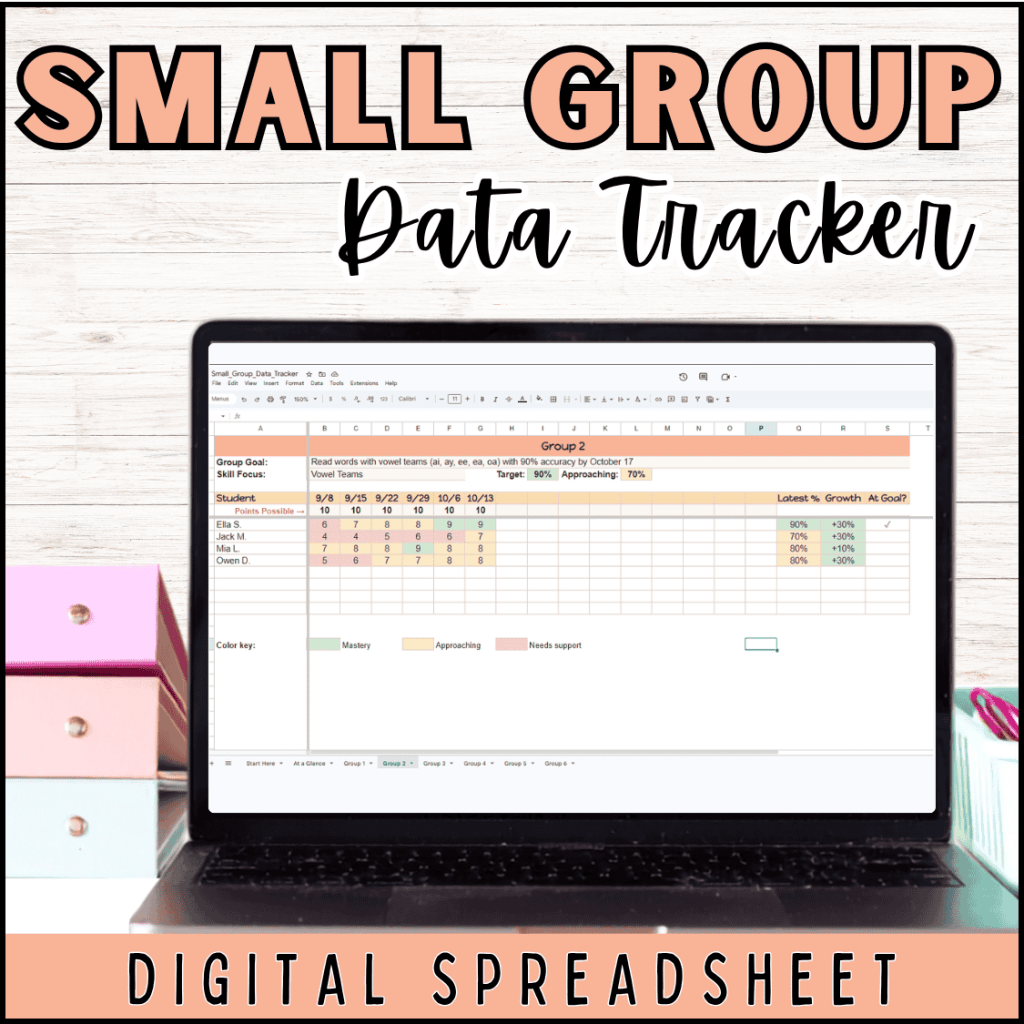
While guided reading groups rarely change, groups based on specific student needs can change often. You’ll know when you need to switch up your small groups by using progress monitoring. Giving each group a specific, measurable goal makes this easy. Each week, do a quick assessment. (It can be as simple as decoding ten nonsense words.) If an entire group has met its goal, it’s time to move on to a new goal. If one student is far behind or ahead of the others, they may need to switch to a new group.
Setting up Your Small Group Table
I personally recommend setting up your small group table in a corner. It keeps it tucked away and helps it feel cozier and quieter.

I had a bookshelf with materials on one end of my table and a small rolling cart with manipulatives and supplies on the other end. The boards behind my table were magnetic chalkboards where I hung anchor charts and posters. My classroom did not have whiteboards, so I used a portable one.
Things to have at your small group table
- Bins or drawers for each group’s materials
- Teacher binder for plans, notes, and data
- Dry erase boards, markers, and erasers
- Pencils, highlighters, markers/crayons, and lined writing paper for students
- Pens, paper clips, sticky notes, a stapler, and a three-hole punch for you
- Manipulatives like pop-its, letter tiles, or sand trays
- Any letter-sound cards, anchor charts, or graphic organizers you regularly use
- Tissues and a small trash can
Tips for staying organized
- Keep a folder in each group bin for worksheets and reading passages. Use paper clips to separate papers for different days.
- At the end of the week, empty the group bins/folders of any materials you’re done with. Refill them with all the materials you’ll need for the following week.
- Leave time at the end of each group to clean up and “reset” the table.
What the rest of your class should do during small reading groups
While you’re meeting with small groups, the rest of your class will most likely be doing other literacy activities. You might call it centers, stations, or independent work.
The activities you choose should be easy for students to complete without support. Simple activities that review foundational skills are best. Here are some ideas:
- Decodable passages (with a skill they learned last week)
- Phonics/spelling worksheets (with a skill they learned last week)
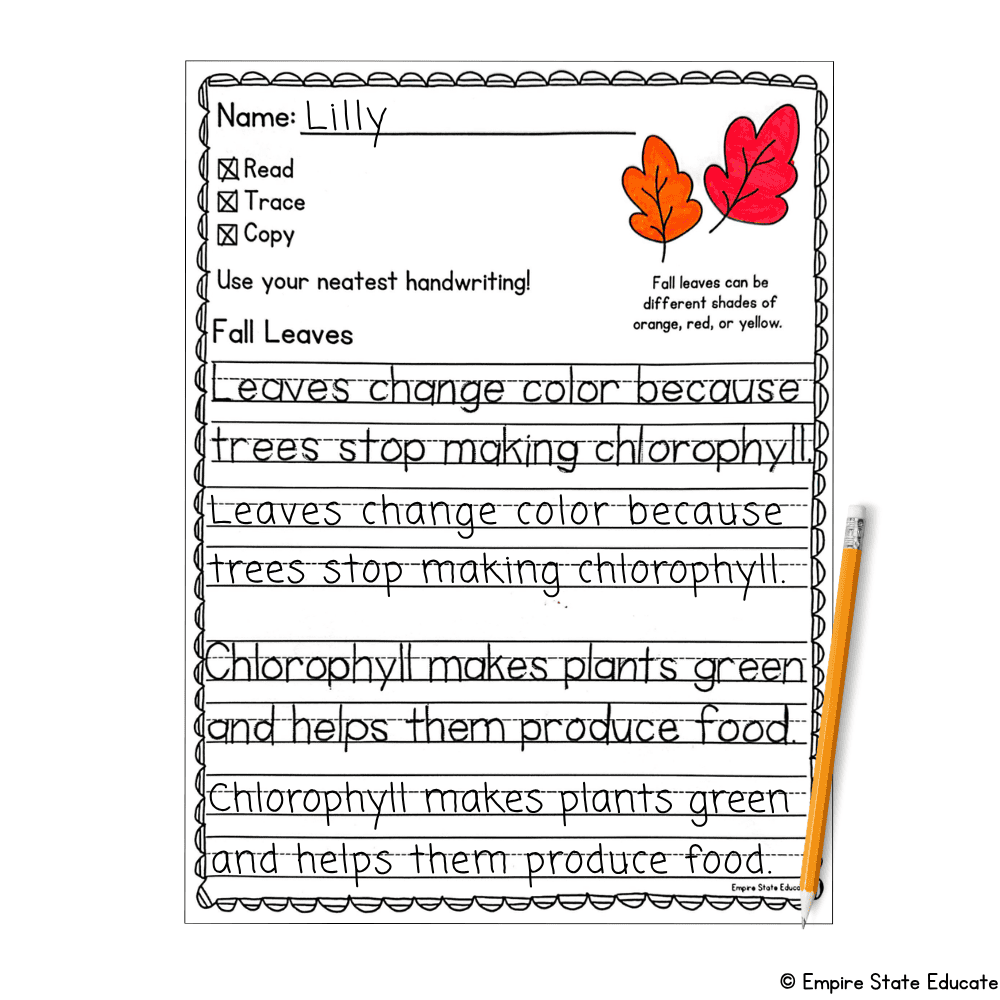
- Handwriting practice
- Fluency practice
Since you won’t be meeting with every small group for the same amount of time, I like giving students two “must-dos” and a “may do” to work through at their own pace. You can read more about that, plus how to set up and manage centers, in this blog post.
Quick Links to Small Group Resources
👉Download your free phonics screening assessment.
👉Grab the small group data tracker spreadsheet.
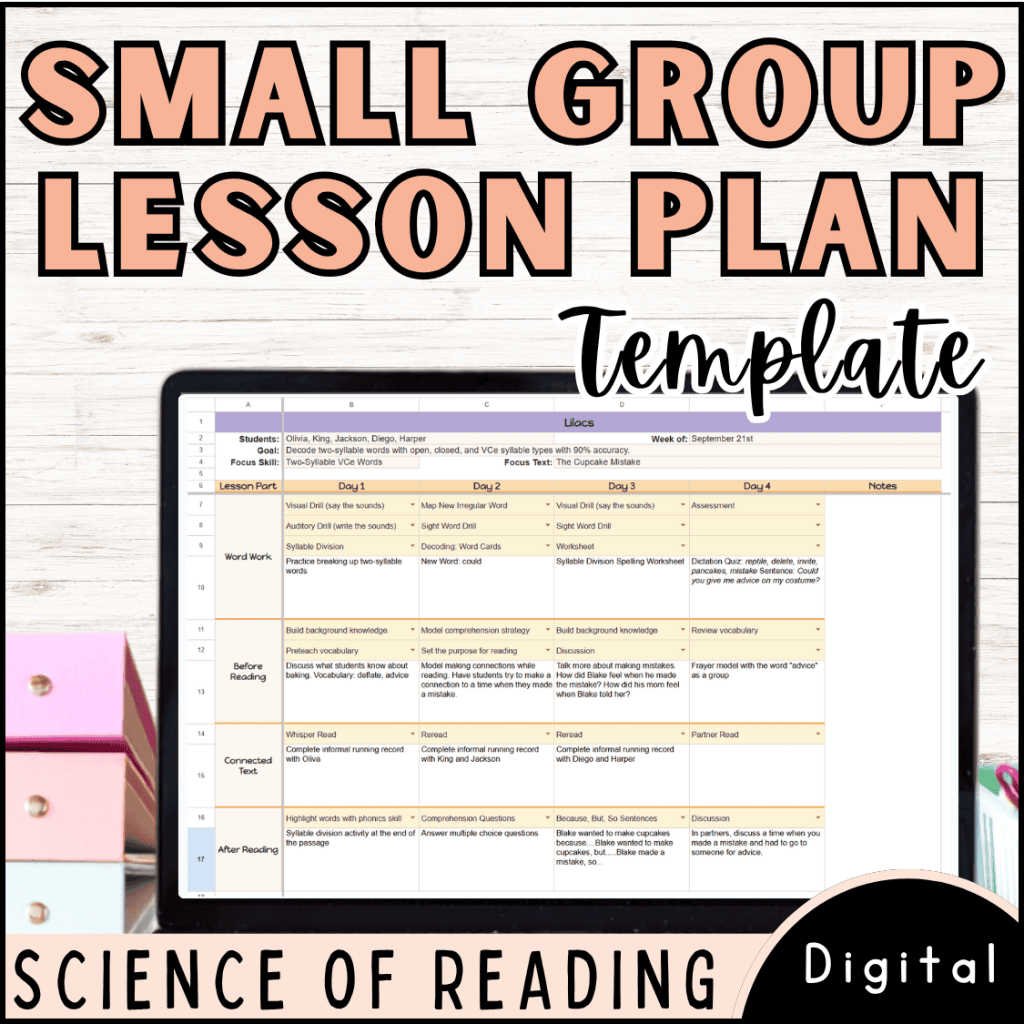
👉Grab the small group lesson planning template.
👉Browse all my structured literacy resources.
👉Learn more about managing centers and small groups.
Pin This Post for Later